 点森科技 - 科技资讯_数码产品_互联网观察_智能硬件
第一部分:残余油挑战与技术演进
Part 1: The Residual Oil Challenge and the Evolution of the Technology
作为本系列文章的开篇,第一部分将系统性地介绍提高采收率技术的核心概念,剖析常规油气田开发面临的关键挑战,并探讨表面活性剂驱(Surfactant Flooding)作为一项破局策略的历史演变及其在应对现代地下残余油动用难题中的战略意义。通过本部分的阅读,读者将清晰地理解为何在全球能源转型的宏观背景下,这项涉及复杂物理化学相互作用的技术依然是石油工程领域不可或缺的基石。
As the opening transition for this series, Part 1 will systematically introduce the core concepts of enhanced oil recovery, dissect the key challenges faced by conventional oil and gas field development, and explore the historical evolution of
surfactant flooding
as a breakthrough strategy, along with its strategic significance in addressing the modern conundrum of mobilizing
underground residual oil
. Through this section, readers will clearly understand why, against the macroeconomic backdrop of global energy transition, this technology—involving complex physiochemical interactions—remains an indispensable cornerstone in the field of petroleum engineering.

在全球能源需求持续攀升的宏观经济与地缘政治背景下,油气田开发的生命周期管理与资源最大化利用已成为现代多学科石油工程的绝对核心。传统的油藏生命周期通常被划分为三个特征鲜明的阶段。一次采油阶段完全依赖于地层内部的天然驱动能量,如溶解气驱、气顶膨胀或水驱,但这种依靠自然压力自喷的开采方式通常只能获得5%至15%的极低采收率。随着地层压力的迅速衰竭,工程界引入了二次采油技术,通过大规模的注水或注气来维持地层压力并提供物理位移能量。然而,尽管注水工程在宏观波及体积上取得了成效,但受限于流体力学中的不利流度比以及多孔介质中极强的表面张力,二次采油通常只能将总采收率勉强提升至20%至40%。这组数据揭示了一个关键事实:即使在经过最详尽的二次水驱作业之后,地下依然有超过60%的原始地质储量(OOIP)以残余油(Residual Oil)的形式,滞留在岩石的微小孔隙中。如何经济、高效地动用这部分规模庞大的滞留储量,构成了三次采油(EOR)技术诞生的直接驱动力。
Against the macroeconomic and geopolitical backdrop of continuously escalating global energy demand, the lifecycle management of oil and gas field development and the maximization of resource utilization have become the absolute core of modern multidisciplinary petroleum engineering. The traditional reservoir lifecycle is typically divided into three distinct phases. The primary recovery phase relies entirely on the natural drive energy within the formation, such as solution gas drive, gas cap expansion, or natural water drive; however, this extraction method, depending on natural pressure for spontaneous flow, usually only yields an extremely low recovery factor of 5% to 15%. As formation pressure rapidly depletes, the engineering community introduced secondary recovery technologies, maintaining formation pressure and providing physical displacement energy through large-scale water or gas injection. Nevertheless, although waterflooding engineering achieved results in macroscopic swept volume, constrained by unfavorable mobility ratios in fluid mechanics and extremely strong surface tension in porous media, secondary recovery typically only manages to push the total recovery factor to between 20% and 40%. This data reveals a critical fact: even after the most exhaustive secondary waterflooding operations, over 60% of the original oil in place (OOIP) remains trapped within the microscopic pores of the rock as
residual oil
. How to economically and efficiently mobilize this large volume of trapped reserves constitutes the direct driving force behind the birth of tertiary recovery, or
Enhanced Oil Recovery (EOR)
technologies.
在探讨如何动用这些
残余油
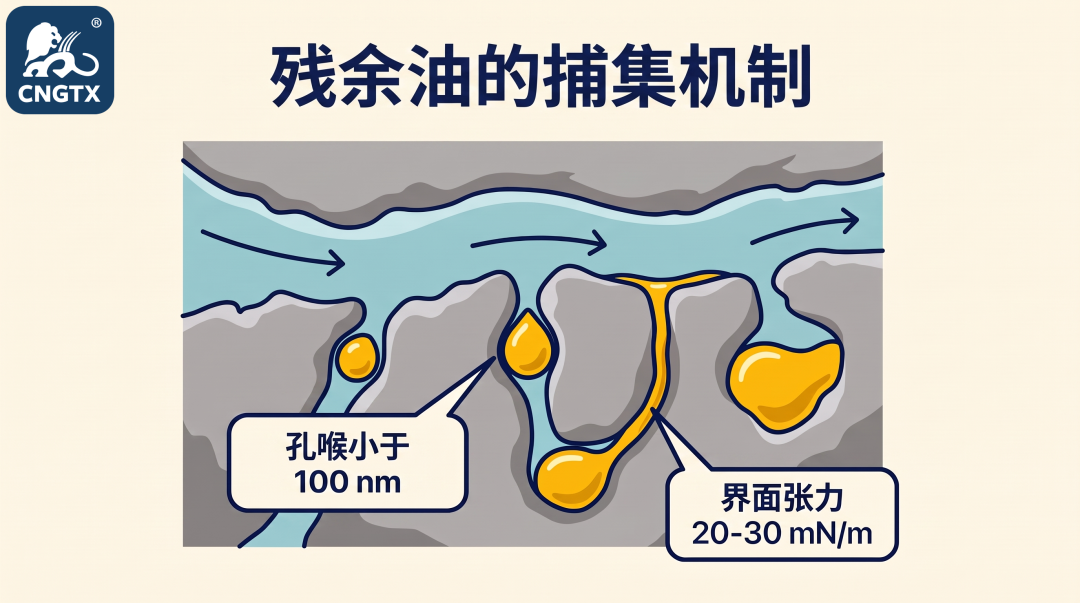
之前,必须深入理解其在地质和流体力学层面的捕集机制。这一核心挑战在于多孔介质中普遍存在且强度很高的毛细管力。在低渗透和特低渗透的砂岩或碳酸盐岩油藏中,孔隙尺寸往往小于 100 nm,孔喉结构错综复杂,连通性极差。在常规的水驱过程中,水相流体不可避免地遵循阻力最小的流体动力学路径,优先沿着裂缝或大孔道发生严重的黏性指进和水窜现象,导致无数微小孔道内的原油根本无法被驱替液波及。即使水相成功进入了微孔,原油和水之间的物理化学不相容性也产生了很高的油水界面张力(通常在20至30 mN/m之间)。这种极高的界面张力与微小孔隙半径共同作用,产生了强大的毛细管阻力,将原油以孤立的油滴、油膜或盲端残余油的形式牢牢“钉”在孔隙内部。传统的流体动力学压力根本无法克服这一微观黏附功,这说明依赖纯机械压力的常规开发手段其增产潜力已接近极限。
Before exploring how to mobilize this
residual oil
, one must deeply understand its trapping mechanisms on geological and fluid dynamic levels. This core challenge lies in the pervasive and very strong capillary forces within porous media. In low-permeability and ultra-low-permeability sandstone or carbonate reservoirs, pore sizes are often smaller than 100 nm, and the pore throat structures are intricately complex with extremely poor connectivity. During conventional waterflooding, the water-phase fluid inevitably follows the hydrodynamic path of least resistance, preferentially causing severe viscous fingering and water channeling along fractures or large pore channels, resulting in crude oil within countless micro-pores being completely unswept by the displacement fluid. Even if the water phase successfully enters the micro-pores, the physicochemical incompatibility between crude oil and water generates a high oil-water
interfacial tension
(typically ranging between 20 and 30 mN/m). This extremely high
interfacial tension
, combined with the microscopic pore radii, produces a powerful capillary resistance that firmly “nails” the crude oil inside the pores in the form of isolated oil droplets, oil films, or blind-end
residual oil
. Traditional fluid dynamic pressure is entirely incapable of overcoming this microscopic adhesion work, indicating that the production enhancement potential of conventional development methods relying purely on mechanical pressure has reached its limit.

面对这一看似无解的物理界限,化学驱(CEOR)技术作为一种系统性的干预策略应运而生。在众多注入化学剂中,表面活性剂因其能够从根本上改变多孔介质内流体热力学状态的独特性质,成为最受关注的核心组分。从历史演变的视角来看,
表面活性剂驱
的理论萌芽由来已久,最早可追溯至近一个世纪前的1920年代。1927年,阿特金森(Atkinson)在学术界首次发表了利用肥皂溶液来显著提高水驱驱油效率的开拓性专利,而同时期的德格鲁特(De Groot)也明确提出了水溶性表面活性剂在提高采收率方面的理论潜力。在那个年代,学界甚至提出了利用油藏中天然存在的环烷酸与注入碱液反应,从而原位生成表面活性剂的超前概念,但受限于当时的化工合成技术和对油藏地球化学认知的匮乏,这些设想长期停留在实验室层面,未能取得实质性的矿场成功。
Faced with this seemingly insurmountable physical boundary, Chemical EOR (CEOR) technology emerged as a systematic intervention strategy. Among numerous injected chemicals, surfactants have become the most studied core component due to their unique ability to fundamentally alter the thermodynamic state of fluids within porous media. From the perspective of historical evolution, the theoretical origins of
surfactant flooding
run deep, tracing back nearly a century to the 1920s. In 1927, Atkinson published the first pioneering patent in academia using soap solutions to significantly improve waterflooding displacement efficiency, while around the same time, De Groot explicitly proposed the theoretical potential of water-soluble surfactants in enhanced oil recovery. In that era, the academic community even proposed the highly advanced concept of utilizing naturally occurring naphthenic acids in reservoirs to react with injected alkaline solutions, thereby generating surfactants in situ; however, constrained by the chemical synthesis technologies and the scarcity of reservoir geochemistry knowledge at the time, these hypotheses remained largely confined to the laboratory and failed to achieve substantial field success.

直到20世纪50年代与60年代,随着石油化工合成技术的飞跃,针对特定苛刻油藏条件定制的低成本合成表面活性剂开始成为研发焦点,美国和前苏联率先在真实油田中开展了表面活性剂驱的矿场先导性试验,早期主要依赖于各类石油磺酸盐。这一跨越确立了化学驱的工程可行性。随后的几十年里,流体力学、界面化学和热力学理论的交叉融合,推动了该技术的不断迭代。到了20世纪80年代,碱-表面活性剂-聚合物(ASP)三元复合驱技术的成功发明与应用,正式宣告了该技术进入了成熟的规模化工业发展阶段。进入21世纪后,伴随着全球常规优质油气储量的加速递减,
表面活性剂驱
技术在中国等国家的多个大型复杂油田中实现了大规模工业应用,成为了继传统水驱之后,石油工业用以大幅提高原油采收率、保障国家能源安全的最核心技术手段之一。
It wasn’t until the 1950s and 1960s, with leaps in petrochemical synthesis technologies, that low-cost synthetic surfactants customized for specific harsh reservoir conditions became the focus of research. The United States and the former Soviet Union pioneered field pilot tests of
surfactant flooding
in real oilfields, initially relying primarily on various petroleum sulfonates. This leap established the engineering feasibility of chemical flooding. Over the subsequent decades, the cross-integration of fluid mechanics, interfacial chemistry, and thermodynamic theories drove the continuous iteration of this technology. By the 1980s, the successful invention and application of the Alkaline-Surfactant-Polymer (ASP) composite flooding technology officially heralded the technology’s entry into a mature stage of large-scale industrial development. Stepping into the 21st century, accompanied by the accelerated decline of global high-quality conventional oil and gas reserves,
surfactant flooding
technology achieved large-scale industrial application in multiple large, complex oilfields in countries like China, becoming one of the most core technological means utilized by the petroleum industry to substantially enhance crude oil recovery and safeguard national energy security following traditional waterflooding.
| 发展阶段 | 历史时期 | 核心里程碑与技术特征 |
|---|---|---|
| 理论启蒙期 | 1920 年代 | Atkinson 发表肥皂溶液驱油专利(1927);De Groot 提出水溶性表面活性剂的采收率潜力;提出原位生成表面活性剂的概念。 |
| 早期矿场试验 | 1950—1960 年代 | 美国与前苏联相继开展矿场先导试验,主要测试合成阴离子与阳离子表面活性剂(如石油磺酸盐)。 |
| 复合技术成熟期 | 1980 年代 | 碱-表面活性剂-聚合物(ASP)三元复合驱 技术发明,标志着大规模工业应用的开端。 |
| 规模化工业应用 | 21 世纪至今 | 在中国等国实现超大规模应用,应对非常规、低渗透油藏;发展弱碱/无碱二元驱及纳米、智能响应体系。 |
展望未来,表面活性剂驱技术的战略重要性将随着能源开发向极端环境(深水、致密岩石、极高温高盐)的转移而愈发凸显。通过上述历史背景的梳理,可以明确:突破残余油物理束缚的唯一途径是深入分子层面重塑流体与岩石的相互作用。这种干预的科学逻辑究竟是如何在地下几千米的漆黑孔隙中运作的?第一部分的宏观探讨为接下来的技术解析奠定了坚实基础。接下来,本系列将过渡到对这些化学药剂核心运作机制的微观剖析。
Looking to the future, the strategic importance of
surfactant flooding
technology will become increasingly prominent as energy development shifts towards extreme environments (deepwater, tight rocks, ultra-high temperature and salinity). By outlining the historical background above, it becomes clear that the only way to break the physical constraints of
residual oil
is to reshape fluid-rock interactions deeply at the molecular level. How exactly does the scientific logic of this intervention operate within the pitch-black pores thousands of meters underground? The macroscopic discussion in Part 1 has laid a solid foundation for the ensuing technical analysis. Next, this series will transition into a microscopic dissection of the core operational mechanisms of these chemical agents.
下期预告:
作为第一部分的总结,我们回顾了驱油技术的演进与地下残余油难以动用的流体力学根本原因。紧接着,本系列的第二部分将带领读者潜入微观世界,详细拆解表面活性剂分子是如何通过大幅降张、反转润湿性以及乳化等五大核心物理化学机理,成功从岩石孔隙中“洗出”原油的。
Next:
As a conclusion to Part 1, we have reviewed the evolution of oil displacement technologies and the fundamental fluid dynamic reasons why
underground residual oil
is difficult to mobilize. Immediately following, Part 2 of this series will lead readers to dive into the microscopic world, meticulously deconstructing how surfactant molecules successfully “wash” crude oil out of rock pores through five core physiochemical mechanisms, including massive tension reduction,
wettability alteration
, and emulsification.